Use the coating that matches the way the part fails, not the colour printed on the can. A shade can be matched afterwards. The wrong chemistry cannot.
For a plant that needs the answer in one pass, the choice is usually one of six:
- Welded, cut or drilled galvanized steel: zinc rich spray paint.
- Fuel, diesel or xylene on the film, or a soft repair that scratches: 2K polyurethane spray paint.
- Polypropylene dashboards, door trims and child parts: plastic spray paint made for PP.
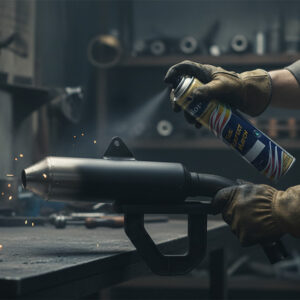
- Exhausts, boilers, flues and other hot parts: heat resistant spray paint on a silicone resin.
- General metal and painted surfaces, with no extreme heat or fuel: acrylic base spray paint.
- A colour repair that must keep its gloss outdoors: anti corrosive clear coat over the colour.
Each row below is the short version. The linked guide is the full one.
Choose by the failure mode
| What is going wrong | Use | Do not use |
|---|---|---|
| Bare steel where galvanizing was cut, drilled or welded | Zinc rich spray, 99.9% zinc | Ordinary grey enamel. It can look similar and it does not protect sacrificially. |
| Petrol, diesel or xylene on the film | 2K polyurethane aerosol | A conventional 1K can. It dries by evaporation and stays vulnerable to fuel and solvent. |
| Scuffed PP trim, dashboard or door moulding | Plastic spray paint for polypropylene | A general-purpose aerosol. PP has very low surface energy, so the film peels. |
| Scorched exhaust, manifold, boiler or flue | Heat resistant silicone-resin spray | Acrylic or NC. A coating that is fine at room temperature can fail in one duty cycle at 400°C. |
| Cosmetic or light-duty metal touch-up | Acrylic base | NC lacquer, which fades, yellows and cracks. |
| A correct colour that still looks dull, or a repair that chalks outside | Anti corrosive clear coat over the colour | Leaving the colour coat unsealed. |
Zinc rich spray paint
Galvanizing is destroyed exactly where the steel is cut, drilled or welded. Zinc is less noble than steel, so a zinc rich film corrodes first and the steel underneath does not. That is the same sacrificial mechanism as hot-dip galvanizing. Color-on zinc spray uses 99.9% purity zinc and dries to a grey matt film, supplied in a 300 g (about 440 ml) aerosol. Ordinary enamel only resembles it. A scratch through enamel undercuts, because there is no sacrificial action.
How zinc rich spray restores galvanizing after welding and cutting
2K polyurethane spray paint
1K aerosol dries by solvent evaporation. 2K pairs a base resin with an isocyanate hardener. Once they cross-link, the film resists petrol, diesel and xylene, and it cures harder than a conventional can. Color-on keeps the hardener in a separate chamber inside the aerosol until the can is activated. After activation the pot life is up to 72 hours. Spray from 20 to 25 cm in thin passes, with 10 to 15 minutes of flash-off between coats. The published comparison rates this 2K film at 500+ hours of UV testing, against 1 to 2 years of outdoor life for a typical 1K.
What 2K polyurethane spray paint is, and how the internal hardener works
Plastic spray paint for polypropylene
A scuffed dashboard or door trim is often replaced whole, because polypropylene is nearly inert. It has very low surface energy, and mould-release wax on a freshly moulded part will stop paint from bonding even when the plastic looks clean. A general-purpose aerosol can look correct on the day and peel later. Use a plastic spray paint built for PP, after the release agent is removed.
Touching up PP dashboards, door trims and child parts
Heat resistant spray paint
Binders that are stable in the shop discolour, chalk and flake once a part cycles through high heat. A coating that is adequate at room temperature can fail in a single duty cycle at 400°C. Color-on’s heat resistant spray is built on silicone resin, with pigments selected to hold colour, in 300 g (about 440 ml) and 120 g (about 180 ml) aerosols. It is the practical repair for exhaust manifolds, silencers, heat shields, boilers, chimneys and flues, where removing the part for a paint booth costs more than the coating.
Touching up exhausts, boilers and hot components
Acrylic base spray paint
For decades the default aerosol in Indian workshops was NC lacquer. It dried fast, then faded, yellowed and cracked as the metal moved. Acrylic base is the general-purpose replacement when the job is not extreme heat, fuel contact, or damaged galvanizing. Color-on acrylic base lays an even, flexible film of 15 to 20 microns, with UV life rated up to 300 hours. It is single component, so the person spraying is not mixing a ratio or racing a pot life. Prime bare steel. Acrylic over bare metal gives away much of its corrosion advantage.
Why acrylic base replaced NC for industrial touch-up
Anti corrosive clear coat
Plenty of rejected touch-ups were the right colour. They failed because the repair was left unsealed, then dulled, chalked, or sat at a different gloss from the panel beside it. Inspectors reject a gloss mismatch as readily as a colour mismatch. An anti corrosive clear coat adds UV, moisture and light abrasion protection, and it is how a repair is brought to the sheen of the surrounding finish.
Sealing touch-ups against weather and corrosion
How to specify the can
Send a physical sample of the component, name the substrate, and describe the service: heat, fuel, outdoor exposure, or galvanized steel. Color-on matches the shade to that sample rather than to a standard colour card. Preparation is the same on every chemistry: clean, degrease, abrade, feather and mask. Most failures that look like a paint problem are a preparation problem.
The cost of sending a part backwards down the line, and a rework SOP a supervisor can hand over, are covered in spray paint for industrial rework. To have a shade formulated, request a quote or call +91 11 47374737.
Questions plants ask
Can one spray paint cover every substrate?
No. Acrylic base covers ordinary metal touch-up. It is the wrong film on damaged galvanizing, on polypropylene, on continuous high heat, and wherever the surface sees fuel or solvent.
What is the difference between 1K and 2K spray paint?
1K dries by solvent evaporation and stays relatively soft. 2K cross-links a resin with an isocyanate hardener. Color-on 2K keeps that hardener sealed in the can until activation, then gives a pot life of up to 72 hours.
Why does paint peel off a dashboard?
Most of this trim is polypropylene. The surface energy is too low for a general-purpose aerosol, and mould release on the part blocks adhesion even when the plastic looks clean.
Is grey enamel the same as zinc spray?
No. Zinc rich spray protects by sacrificing the zinc, which is the idea behind galvanizing. Enamel is only a barrier. Color-on zinc spray uses 99.9% purity zinc.
When is a clear coat required?
When the colour is already acceptable, but the repair will weather, take handling marks, or sit next to a glossier factory finish. A correct colour at the wrong sheen still fails inspection.