The best touch-up spray paint is the one that matches the component, not the one with the closest colour on the shelf. A scratch on galvanized steel, a scuff on a polypropylene dashboard, and a chip on an exhaust are three different repairs. The same can will not hold on all three.
For paint defects on a production part, work in this order: identify the substrate and what the part sees in service, prepare the defect, spray thin coats of the matching chemistry, then seal the repair if the surrounding finish is glossy or lives outdoors. The chemistry choice is set out in which industrial touch-up spray paint to use. This page is the repair itself.
Which touch-up spray paint is best for the component?
| Component | Best touch-up spray paint | Why |
|---|---|---|
| Painted metal, machinery, enclosures | Acrylic base | Flexible film of 15 to 20 microns. The sensible replacement for NC lacquer, which fades and cracks. |
| Parts that see petrol, diesel or xylene | 2K polyurethane | Resin and isocyanate hardener cross-link. A 1K can stays soft and softens again on fuel. |
| Galvanized steel after a weld, cut or hole | Zinc rich, 99.9% zinc | Sacrificial protection, the same idea as galvanizing. Grey enamel only looks similar. |
| Dashboards, door trims, PP child parts | Plastic spray paint for polypropylene | PP has very low surface energy. A general-purpose aerosol peels. |
| Exhausts, manifolds, boilers, flues | Heat resistant silicone-resin spray | A normal coating can fail in one duty cycle at 400°C. |
| A colour repair that must match gloss outdoors | Anti corrosive clear coat over the colour | Inspectors reject a gloss mismatch as readily as a colour mismatch. |
Shade is a separate step. Color-on matches the can to a physical sample of the component, not to a standard colour card. Send the sample with the substrate and the service conditions.
How to touch up paint defects
Nearly every touch-up that fails was a preparation failure. The paint is what you see, so the paint gets blamed. Do these five steps in order before you spray. They are the same steps a line can be handed as a rework method, which is covered in spray paint for industrial rework.
1. Clean
Remove dust, coolant and handling soil. Anything left under the film becomes a place where the coating lifts.
2. Degrease
Solvent-wipe the area. Fingerprints are oil. Oil is the usual cause of fisheyes and poor adhesion on a repair that otherwise looked correct.
3. Remove damaged coating and corrosion
Scrape back every flake of lifted film. Abrade to sound material with 180 to 320 grit. Painting over live corrosion lasts months, not years. Once bare metal is open, corrosion spreads under the coating that still looks intact. This is the step people skip, because the defect looks worse before it looks better.
4. Feather the edge, and prime bare metal
Taper the edge of the surrounding coating so the repair blends instead of sitting proud. On bare steel, prime. Acrylic over bare metal gives away much of its corrosion resistance.
5. Mask
Mark the boundary of the repair. An unmasked touch-up is how a 10 mm defect becomes a 200 mm visible patch.
Spraying the defect
Shake the can for the full time on the label. Pigment settles, and a short shake shifts both shade and gloss.
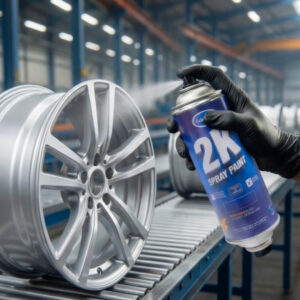
Build the film in thin passes. Two light coats beat one heavy coat, which sags and cures soft. For Color-on 2K, spray from 20 to 25 cm and allow 10 to 15 minutes of flash-off between coats. After the can is activated, the pot life is up to 72 hours. The hardener stays sealed in its own chamber until you release it, so an unopened can is not already curing on the shelf.
Let the repair cure before it is handled, and longer again before parts are stacked or packed. If the panel around the defect is glossy, or the part lives outdoors, finish with an anti corrosive clear coat so the repair weathers at the same rate as the factory film.
Defects this repair is for, and defects it is not
Touch-up spray paint is the right repair when the defect is local: a run, a scratch, a chip, a scuff, a weld burn on galvanizing, a small area of lost coating. It is the wrong repair when the coating has failed across the whole part, when the substrate is rotten under the paint, or when the part can go back through the original process more cheaply than a hand repair.
On polypropylene, remove mould-release wax before you spray. The part can look factory-clean and still refuse the paint. On hot parts, do not use acrylic or NC. On fuel-wetted parts, do not use a 1K aerosol.
Questions about touch-up spray paint
Which is the best touch-up spray paint for my component?
Match the chemistry to the component and to what touches it in service. Acrylic base for ordinary painted metal. 2K polyurethane where the film sees petrol, diesel or xylene. Zinc rich spray, at 99.9% zinc, where galvanizing has been cut or welded. Plastic spray paint on polypropylene trim. Heat resistant silicone-resin spray on exhausts and boilers. Then match the shade to a physical sample.
How do I touch up paint defects?
Clean, degrease, abrade back to sound material with 180 to 320 grit, feather the edge, prime bare metal, and mask. Spray thin coats. Seal with a clear coat when gloss or outdoor life matters. Skipping the abrasion step is the usual reason a repair lifts later.
What is the best spray paint for paint defects?
There is no single best can. The best spray paint for a paint defect is the one whose film survives the same conditions as the original coating. A perfect colour in the wrong chemistry still fails inspection, either by peeling, by softening on fuel, or by showing a different gloss.
Can I spray over the defect without sanding?
No. Loose coating and corrosion have to come off. Abrade with 180 to 320 grit and feather the edge, or the new film is sitting on a layer that is already letting go.
How do I get the colour to disappear?
Send a physical sample of the component. A card match is not the same thing. Also match the sheen. A correct colour under the wrong gloss still reads as a repair from a few metres away. Where that matters, use an anti corrosive clear coat over the colour.
To have a can formulated for the part, request a quote or call +91 11 47374737.