A scuffed dashboard, a scratched door trim, a scratched pillar cover: on paper these are trivial defects. In practice they are among the most expensive rejections on an assembly line, because the usual answer is to replace the whole moulding. A dashboard is not a small part, it is not cheap, and pulling one out of a built vehicle costs more in labour than the component itself.
The alternative is to repair the defect where it sits. That works, but only with a coating engineered for the substrate, because plastic spray paint for PP is a genuinely different problem from painting metal.
Why Polypropylene Resists Paint
Polypropylene is a polyolefin. Its molecular structure is non-polar and chemically inert, which gives it very low surface energy. Paint needs something to grip, chemically or mechanically, and PP offers almost nothing on either count. Coat it with a general purpose product rather than a plastic spray paint built for the substrate, and the film will look perfect on the day and peel in sheets within months.
This is not a quality problem with the paint. It is a compatibility problem. The same coating that performs for years on a steel bracket has nothing to bond to on a PP trim panel.
Two further complications make PP harder than most people expect:
- Mould release residue. Injection moulded parts carry silicone or wax release agent on the surface from the moment they leave the tool. It is invisible, and it defeats adhesion completely. Parts that look factory-clean are often the worst offenders.
- Flex. Trim components move, and they get pressed, clipped and handled. A hard, brittle film cracks at exactly the points where the part deflects.
Why Touch-Up Spray Is the Right Answer for Plastic Child Parts
Plastic components make an unusually strong case for touch-up compared with any other repair route.
| Alternative | Why it fails on plastic trim |
|---|---|
| Replace the moulding | Highest cost path. Part cost plus disassembly labour plus stock holding, for a defect that may be 10 mm across. |
| Send it through the paint booth | Requires removal from the assembly. Plastics also cannot take the bake schedules used for metal. |
| Spray gun on the line | Overspray onto adjacent trim, wiring and upholstery. Setup and masking cost exceeds the repair. |
| Generic aerosol | Adheres initially, peels later. Turns a cosmetic defect into a warranty claim. |
| PP-specific touch-up spray | Repairs in place, controlled overspray, no disassembly, correct chemistry for the substrate. |
The financial argument is straightforward. A scratched dashboard replaced is a four-figure decision. The same dashboard touched up correctly is a few minutes and a fraction of a can. The wider economics of containing defects rather than escalating them is covered in our guide to cutting industrial rework cost.
Surface Preparation for PP
On metal, preparation improves the result. On polypropylene, preparation is the result. Work through this in order:
- Wash. Remove dust, handling soil and interior cleaning products. Many dashboard dressings are silicone based and are catastrophic for adhesion.
- Degrease thoroughly. This is the step that removes mould release residue. Do not skip it because the part looks clean; on a new moulding it is the single most important operation.
- Abrade lightly. A fine scuff creates mechanical key without destroying the grain texture. On grained dashboard and trim surfaces, work with the grain and stay light, because a polished patch is as visible as a colour mismatch.
- Wipe again after abrading to remove sanding dust, then let it flash off fully.
- Mask generously. Interior trim sits next to glass, upholstery and switchgear. Overspray on a seat is a bigger problem than the original scratch.
Then qualify the result before it becomes standard practice: a cross-hatch tape test on a scrap moulding of the same material tells you in two minutes whether your preparation is adequate for the plastic spray paint to bond. Test on your actual part, not a supplier’s panel, because grades and release agents differ between mouldings.
Applying Plastic Spray Paint on Trim
Shake for the full stated time. Spray in thin, overlapping passes from the recommended distance and let each coat flash off before the next. Two or three light coats will always outperform one heavy coat, which on a vertical trim face will run, and on a horizontal dashboard face will stay soft and pick up dust.
Match sheen carefully. Interior plastics are usually specified at a low gloss to control windscreen reflections, and a repair at the wrong sheen is obvious in daylight even when the colour is exact. Approve the finish under the lighting your inspectors actually use.
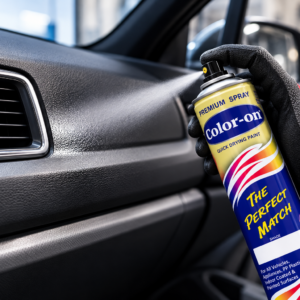
Color-on PP and ABS Spray Paint
Color-on manufactures a plastic spray paint formulated specifically for polypropylene and ABS surfaces with appropriate surface preparation. Its intended applications cover exactly the components this article is about:
- PP surfaces: car dashboards, door trims and interior mouldings.
- ABS surfaces: electric bike panels and rickshaw body parts.
- Nylon components.
It is supplied in 300 g (approximately 440 ml) and 120 g (approximately 180 ml) aerosols. The smaller can is the one most line and service teams want, because interior repairs consume very little material and a fresh can gives a predictable spray pattern.
Every shade is matched to a sample you send rather than to a standard card. On interior trim this matters more than anywhere else on a vehicle: dashboard greys and blacks drift measurably between mouldings, batches and suppliers, and a repair matched to a generic code will not disappear.
Getting a Shade Matched to Your Moulding
Send us a physical sample of the component, the polymer grade if you have it, and the finish you need. We will formulate and colour match against your actual part. You can see the wider Color-on product range, including clear coats and primers that pair with plastic systems.
Request a quote and shade match, or call our Delhi office on +91 11 47374737.