Most plants track scrap carefully and rework loosely. That is usually backwards. A finish defect found at final inspection rarely means the part is lost — it means the part travels backwards through the line. How far backwards it travels is what decides your true cost per defect, and the honest answer at most factories is: further than it needs to.
Touch up spray paint exists to shorten that journey. Used properly, it turns a booth-cycle repair into a bench-level repair. Used carelessly, it creates a defect that passes visual inspection today and fails in the field eight months from now. This guide is about the difference.
Contents
- What rework actually costs you
- Where touch up spray paint fits — and where it doesn’t
- The five preparation steps that decide whether a repair holds
- Matching the formulation to the substrate
- Colour matching: why "close enough" fails inspection
- Qualifying touch up spray paint before it reaches the line
- A rework SOP you can hand to the line
What Rework Actually Costs You
The number in your rework work orders is not the real number. Analysis of manufacturing rework consistently finds that true rework cost runs 2.0–2.5× the direct labour recorded against it, once you count occupied capacity, re-inspection, expediting and the schedule disruption behind it.
The bigger problem is the rework nobody logs. In-process touch up — an operator quietly fixing a run or a scratch without raising a rework order — is the largest hidden category. Plants that measure it properly often discover that 20–30% of what they record as cycle time is actually repair time wearing production time’s badge.
Finishing operations are not exempt. In powder coating, a 6% rework rate is considered low — yet on a ₹40 crore finishing operation, 6% still means roughly ₹2.4 crore of product being handled more than once.
And repair is disproportionately expensive relative to original application. Shipyard coating data makes the point sharply: applying coating costs around $10 per square metre, while repairing a 5 cm² damaged area costs roughly $125 — a repair cost per unit area many multiples higher than doing it right the first time.
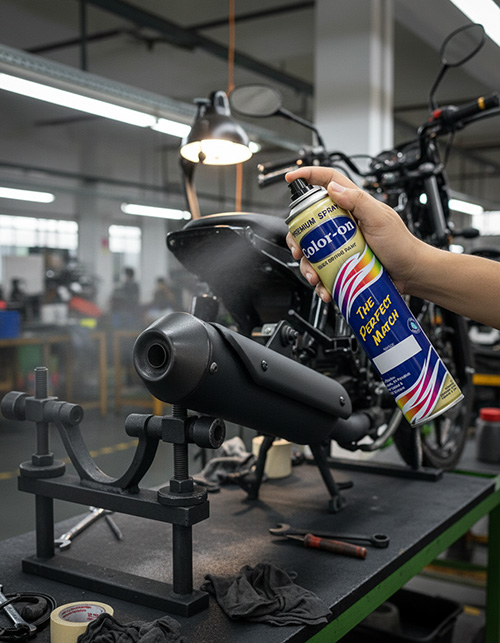
The economic case for touch up spray paint is not that repairs are cheap. It is that booth repairs are expensive, and most defects do not need a booth.
Where Touch Up Spray Paint Fits — And Where It Doesn’t
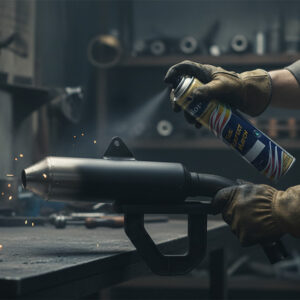
An aerosol is not a substitute for a spray gun. It is a substitute for mobilising a spray gun. Those are different decisions, and confusing them is where plants go wrong in both directions.
| Situation | Right tool | Why |
|---|---|---|
| Handling scratch, edge chip, fixture mark, weld burn-through spot | Aerosol touch up | Defect is smaller than the setup cost of a gun |
| Repair on an assembled or wired unit | Aerosol touch up | Disassembly cost exceeds the repair itself |
| Field repair at customer site | Aerosol touch up | No compressor, no booth, no cleanup |
| Full panel, blend across a large flat face | Spray gun | Better atomisation and fan control over area |
| High-volume repeat refinishing | Spray gun | Bulk material cost per part is lower |
The practical rule most plant managers land on: if the repair is smaller than a spread hand and the part is already assembled, the aerosol wins on total cost even when its material cost per millilitre is higher. Once the defect area grows past that, the gun’s transfer efficiency starts paying for the setup.
There is also a competence argument. A spray gun rewards a skilled operator and punishes an unskilled one. A well-formulated aerosol has no mixing ratio to get wrong, no viscosity to adjust and no gun to clean — which matters when the person doing the repair is a line operator on shift, not your best painter.
The Five Preparation Steps That Decide Whether a Repair Holds
Nearly every touch up failure traced back honestly turns out to be a preparation failure, not a paint failure. The coating gets blamed because it is the visible layer. Work through these in order:
- Clean. Remove dust, coolant and handling soil. Anything left under the film becomes a delamination site.
- Degrease. Solvent-wipe the area. Fingerprints are oil, and oil is the single most common cause of fisheyes and poor adhesion on otherwise correct repairs.
- Remove damaged coating and corrosion. Scrape back all flaking or lifted film. Abrade to sound substrate with 180–320 grit. Painting over live corrosion buys you months, not years — once bare metal is exposed, corrosion spreads beneath the surrounding intact coating.
- Feather and etch. Taper the edge of the surrounding coating so the repair blends rather than sits proud. On bare metal, prime.
- Mask. Define the repair boundary. An unmasked touch up is how a 10 mm defect becomes a 200 mm visible patch.
Skipping step 3 is the expensive one. It is also the most commonly skipped, because it is the only step that makes the defect look worse before it looks better.
Matching the Formulation to the Substrate
"Touch up spray paint" is a category, not a product. Matching chemistry to service condition is what separates a repair that survives from one that quietly fails QA six months later.
| Service condition | Formulation family |
|---|---|
| Bodyshop-grade gloss, fuel and chemical exposure | 2K polyurethane |
| Solvent or thinner contact in service | Xylene resistant |
| Exhaust, ovens, engine components | Heat resistant |
| Galvanised, weld repair, corrosion-critical | Zinc rich |
| Polymer housings, trim, dashboards | Plastic-specific |
| Electrical assemblies, tracking risk | Anti-track, electro passivation |
| Safety marking, visibility | Fluorescent |
Color-on manufactures 18+ formulations across three families — premium coatings including 2K polyurethane, xylene resistant and heat resistant; regular industrial and automotive touch up sprays in acrylic, NC, industrial, plastic and zinc; and specialty products for passivation, fluorescent marking, primer and anti-track applications. You can see the full breakdown on our product range page.
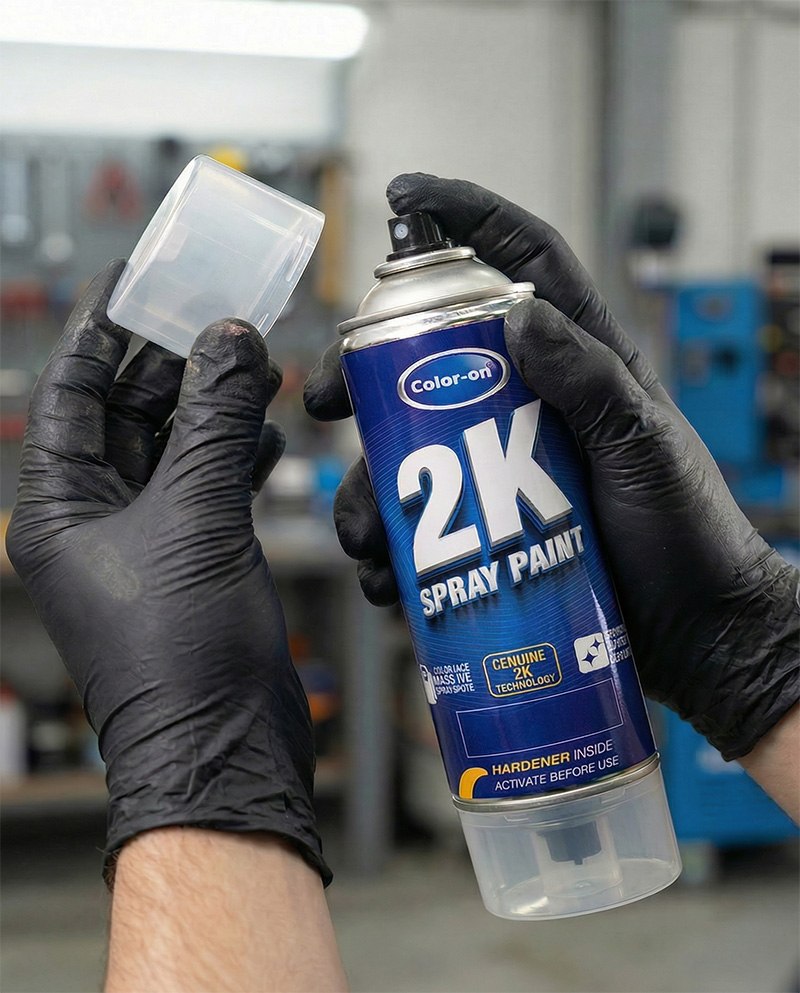
The 2K question deserves its own note. Conventional aerosols are single-component — they dry by solvent evaporation and never fully crosslink, which is why they stay vulnerable to fuel and solvent. A true 2K polyurethane spray paint carries a hardener in the can that is activated before use, producing a chemically crosslinked film — we explain the mechanism in detail in what is 2K polyurethane spray paint. For any repair that will see petrol, brake fluid, or aggressive cleaning, that distinction is the whole ballgame.
Colour Matching: Why "Close Enough" Fails Inspection
A repair that is structurally perfect and half a shade off is still a rejected part. This is the failure mode that frustrates plant teams most, because the work was done correctly.
Standard shade codes are a starting point, not an answer. Real production surfaces drift — batch variation in the original coating, film build differences, UV exposure on parts that have been in stock, and metallic or pearl orientation that changes with application angle. Matching to a code rather than to your actual component is why off-the-shelf touch up material so often disappoints on a line that has been running for years.
The workable approach is to match against a physical sample of the production part, under controlled lighting, and to re-qualify when the base coating supplier or batch changes. Every Color-on product is formulated to a customer’s submitted shade rather than to a generic code — which is the entire reason our OEM clients report rejection reductions rather than marginal improvements.
Qualifying Touch Up Spray Paint Before It Reaches the Line
Treat a touch up material like any other incoming production input. Before it is approved for line use, it should clear:
- Adhesion. Cross-hatch tape test on your actual substrate and your actual pretreatment — not on a test panel from the supplier.
- Corrosion resistance. Salt spray to your specification. A common industrial benchmark is 500 hours with no more than 6 mm (¼ inch) of creep from the scribe. Color-on products are tested to 500+ hours.
- Colour under your lighting. Approve under the light your inspectors actually use, and check for metamerism — two samples matching under one light source and diverging under another.
- Gloss and texture. A correct colour at the wrong gloss reads as a defect from three metres away.
- Recoat and handling window. If the repair cannot be handled within your takt time, it will not be used as intended.
A Rework SOP You Can Hand to the Line
Most touch up quality problems are process problems, not skill problems. A one-page standard removes the variation:
- Classify the defect — is it within the approved touch up envelope by size and location? If not, route to booth.
- Clean, degrease, abrade to sound substrate, feather, mask.
- Prime if bare metal is exposed. Respect the primer’s recoat window.
- Shake the can for the specified time. Under-agitation is a leading cause of shade and gloss deviation.
- Apply in thin passes from the specified distance. Two light coats consistently outperform one heavy coat; heavy coats sag, trap solvent and cure soft.
- Respect flash-off between coats and full cure before handling or packing.
- Inspect under the approved light source. Record the defect type.
That last step is the one that pays compounding returns. Touch up fixes the part in front of you; the defect log tells you which fixture, which operator station or which handling step is generating the damage in the first place. Plants that treat their rework record as process data usually find that a handful of root causes account for most of the volume.
The Point of Touch Up Is Not Repair
It is containment. A good touch up spray paint programme keeps a finish defect from escalating into a disassembly, a booth cycle, a delayed shipment or a warranty claim. The paint is a small line item; the cycle it prevents is not.
Color-on is manufactured by Indian Aerosols Pvt Ltd, sister concern of Aeroaids Corporation — the company that introduced aerosol touch up to India in 1987. Every product is formulated to the customer’s substrate, shade and service condition rather than sold from a standard shade card.
If you are carrying a rework rate you cannot explain, send us the component, the shade reference and the service condition. Request a quote and colour match — or call our Delhi office on +91 11 47374737.